
- Project Summary
- Study Duration
- Objectives
- Team Members
Project Summary
Nurse-led continuum of care approach for addressing diabetes in Nepal
Study Duration
Feb 2018 – Nov 2021
Objectives
Objective 1: Develop a culturally tailored and locally contextual diabetes training program for nurses:
A 9-day Training of Trainers (TOT) was the first training based on the developed manual from 16th to 25th June 2019 followed by a 6-day Training on 26th July 2019 in Dhulikhel and the third training from 20 Nov to 22 Nov 2019. Altogether 22 nurses and 7 ANM were trained. During this time, we planned for online training of the nurses of the government centers. With six successive sessions of 1-2 hour where we trained 4 government nurses, 1 community health worker, and 3 nurses from the Dhulikhel Hospital outreach center.
National Health Training Center (NHTC) [Government of Nepal] endorsed our manual on 29th July 2019 with the joint agreement of all national stakeholders Nepal Nursing Council (NNC), Nursing Association of Nepal (NAN), Diabetes and Endocrinology Association of Nepal (DEAN), Nepal Diabetes Association (NDA), Nepal Diabetes Society (NDS) and Nursing and Social Service Division [Government of Nepal] after having final sharing meeting on ”Diabetes Training Manual for Nurses’ at National Health Training Center (NHTC).
Objective 2: Improve diabetes awareness in the community through nurse-led diabetes awareness campaigns
More than 8000 people were screened, and we have been able to trace out 785 diabetes patients, and 677 people within the pre-diabetic range. These people were continually followed up and traced for their investigations.
An orientation training was provided to around 141 female community health volunteers at different centers associated with Kavre and Sindupalchowk district. Additionally, we trained 41 FCHVs with practical skills in the centers targeted for the diabetes club and involved them in anthropometric measurements and counseling during the camps.
We also organized institutional screening after the covid and equipped the health centers with glucometers and strips for institutional screening, additionally, we also equipped the centers with diabetes clubs with weighing machines, BP machines, and height and weight measuring equipment.
Objective 3: Detect diabetes patients early and link them to healthcare
The patients diagnosed at the screening camp or the regular diabetes patients traced out in the camp were followed up for the check up and further investigations in the camp as well as through the telephone and their records of investigations were stored in the electronic health record system. The patients who visited the hospital were counseled by the diabetes nurses. After the institutional screening, the patients, newly diagnosed and the pre-diabetes were counseled along with foot screening and referred for further check-ups when necessary by the diabetes nurses.
Objective 4: Improve the quality of care provided to the diabetic patient through a nurse-led diabetes management program.
The newly diagnosed, old-diagnosed diabetes patients as well as those under the prediabetes category were invited to the diabetes club session to teach them about diabetes and dietary and lifestyle modification counseling. Also, the idea of the club was introduced in order to carry out monthly meetings and discuss such matters time and again. We organized 3 sessions for Panauti Municipality, 3 sessions for Banepa Municipality and 2 sessions for Dhulikhel Municipality. Out of these, we selected 2 centers from Panauti, 2 centers from Banepa and one center from Dhulikhel for the Diabetes club. Likewise in our outreach centers, we organized one session in Bahunepati, Dhungkharka, Manekharka, Kattike, Salambu, and Baluwa and 2 sessions in Dapcha and Bolde. The health centers were also equipped with screening instruments for regularity of screening. 2 government health staff were also trained in these centers.
Electronic Health Records of the patients and continuous records of the follow-up from the camp to the hospital, along with a clinical decision support system in both browser and app versions and being used by the diabetes nurses in the community.
Objective 5. Initiate advocacy efforts by using this approach as a feasible and effective model of diabetes prevention and management
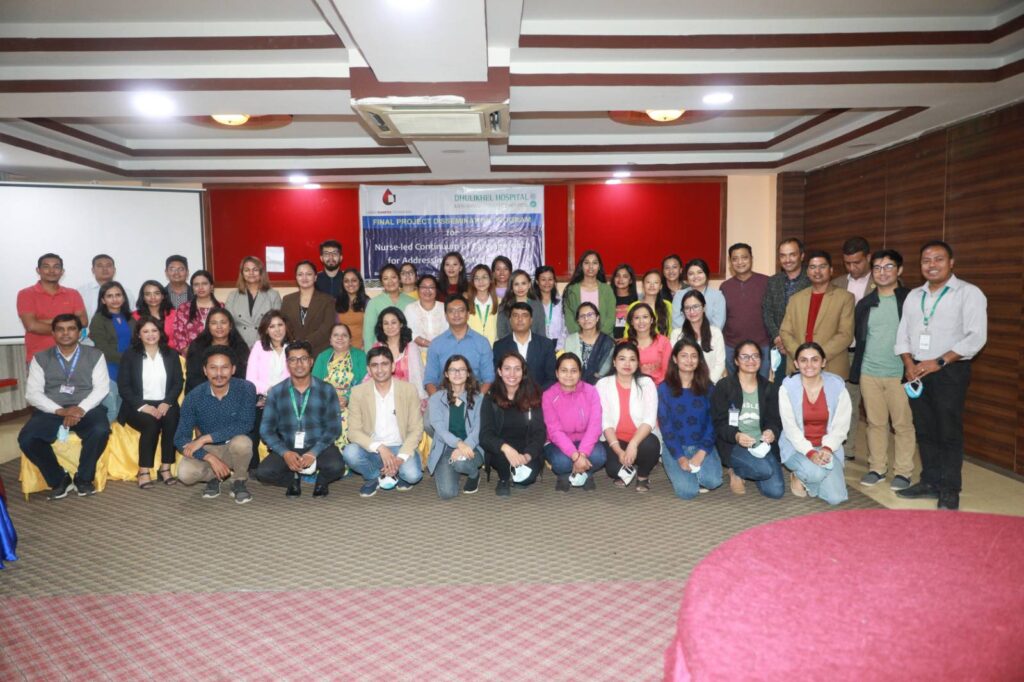
Dissemination of this program was done inviting representatives from EDCD, nurses from different institutions and diabetes related institutions. The diabetes club continued where blood collection and distribution of their medicines (insured) at the community level is going on. News published in newspapers like Chesta Weekly stories being mentioned on the WDF site.
Team Members
Investigators: Dr. Biraj Karmacharya
Co-Investigators: Dr. Abha Shrestha
Coordinators: Ms. Rabina Shrestha
Research Assistants: Ms. Jenisha Shrestha, Ms. Nistha Shrestha, Mr. Krishna Barun