

- Project Summary
- Study Duration
- Objectives
- Outcomes
- Team Members
- Publications
Project Summary
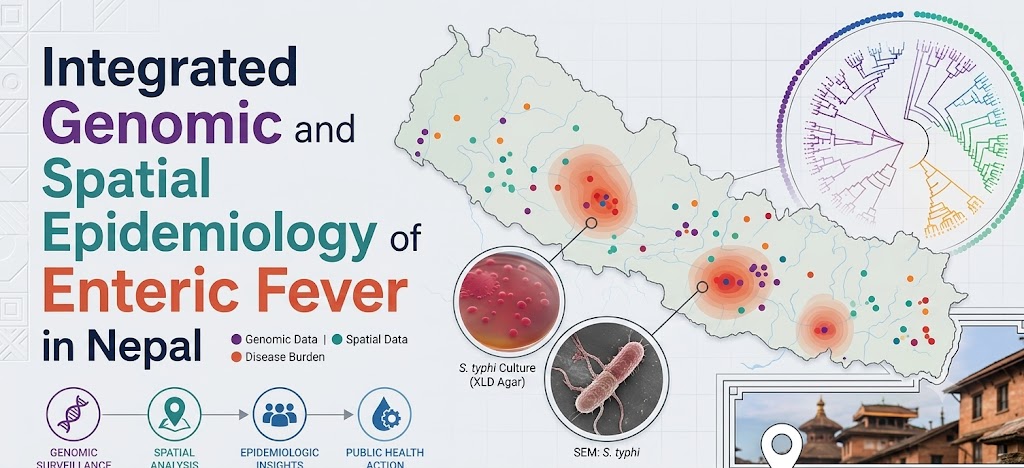
Enteric fever caused by Salmonella Typhi and S. Paratyphi A remains a major public health issue in Nepal. Earlier genomic studies showed dominant S. Typhi lineages and shifting S. Paratyphi A genotypes, but there is limited understanding of how these populations have evolved from 2016–2024 or how recent public health interventions have shaped transmission. Two key public health events, the COVID-19 pandemic and the introduction of Typhoid conjugate vaccine (TCV) likely shaped the genetic diversity and transmission dynamics of these pathogens. Over the past decade, extensive whole-genome sequencing (WGS) data on Salmonella Typhi and S. Paratyphi A have been generated in Nepal through surveillance efforts such as the Surveillance of Enteric Fever in Asia Project (SEAP), yet these data have not been fully leveraged to understand long-term pathogen evolution and transmission. In particular, integration of genomic data with spatial epidemiology using geographic information remains limited, constraining insights into phylogenetic trends, geographic spread, and transmission dynamics at both local and national scales. Similarly, major events such as the 2018 enteric fever outbreak have not been examined in sufficient genomic and spatial detail to clearly distinguish outbreak-associated strains from endemic circulating populations. These analytical gaps are compounded by limited local capacity for integrated molecular and spatial epidemiology, including the lack of standardized protocols and sustained training, which restricts the routine use of such approaches for surveillance and outbreak response in Nepal and for other endemic enteric diseases such as cholera.
Study Duration
11/23/2025 – 10/31/2026
Objectives
To apply integrated genomic and spatial epidemiology to comprehensively assess the evolution, transmission dynamics, and antimicrobial resistance patterns of enteric fever in Nepal from 2016–2024, including changes before, during, and after major public health interventions such as the COVID-19 pandemic and TCV introduction, and to investigate the 2018 outbreak to determine whether it resulted from clonal expansion or multiple unrelated strains. To strengthen capacity by establishing sustainable infrastructure, workflows, and training in molecular and geospatial analysis, supporting improved outbreak preparedness, surveillance, and response for enteric fever and other endemic enteric diseases through collaborative partnerships with national and international institutions.
Outcomes
The expected outcome of this study is an improved understanding of the genomic and spatial transmission dynamics, antimicrobial resistance patterns, and outbreak drivers of enteric fever in Nepal, alongside strengthened national capacity through sustainable infrastructure and trained personnel to integrate molecular and geospatial epidemiology into routine surveillance, outbreak investigation, and public health decision-making for enteric fever and other endemic enteric diseases.
Team Members
Principal Investigator(s): Dr. Dipesh Tamrakar
Project Director: Dr. Dipesh Tamrakar
Co-Investigator(s): Prof. Dr. Rajeev Shrestha, Mr. Nishan Katuwal, Ms. Aastha Shrestha, Mr. Sabin Bikram Shahi, Mr. Shiva Ram Naga
Project Coordinator: Mr. Shiva Ram Naga
Supported by: Gates Foundation
Collaborating Partners: Stanford University
Publications: Not Yet Published
Publications
Not Yet Published