

- Project Summary
- Study Duration
- Objectives
- Outcomes
- Team Members
- Publications
Project Summary
In Nepal, the Government of Nepal and local organizations have installed thousands of biodigesters over the last 30 years in rural communities where around half of the households own animal livestock such as cattle, buffalo, and goats. These biodigesters are a household cooking intervention that converts human and animal waste into a clean-burning cooking fuel and effluent can be used as a fertilizer for crops. So, to ensure sufficient production of biogas and fertilizer, the caretaker responsible for maintaining the biodigester may often collect the animal waste manually adding to the inlet and/or mixing the cow dung and urine (slurry) by hand/agitator in the inlet. Such practice increases the risk of potential hand contamination in comparison to those with only livestock and no biodigester. Along with the exposure to the inlet, the improper functioning of biodigester leads to untreated animal and human waste being present in the effluent which is mostly used as a fertilizer for crops, increasing the exposure to contamination.
An observational study has found the use of biodigester in Nepal has led to a 31 percent higher risk of incident diarrhea among children under 5 years old. Not only the use of biodigester but the compost piles in the household without biodigester may increase the risk of exposure to bacterial pathogens like E. coli and Salmonella. In addition to the diarrhoeal disease, exposure to animal waste may contribute to antibiotic-resistance transmissions, as small livestock and poultry are often carriers of clinically important antibiotic-resistant E. coli and the major concern is multidrug-resistant extended-spectrum beta-lactamase (ESBL)-producing E. coli.
Study Duration
Mar 2023 to Dec 2023
Objectives
The overall aim is to understand how different waste management strategies impact the exposure to fecal contamination (measured by the concentration of E. coli) and clinically important antibiotic-resistant bacteria (measured by the concentration of multidrug-resistant extended-spectrum beta-lactamase (ESBL)-producing E. coli).
Outcomes
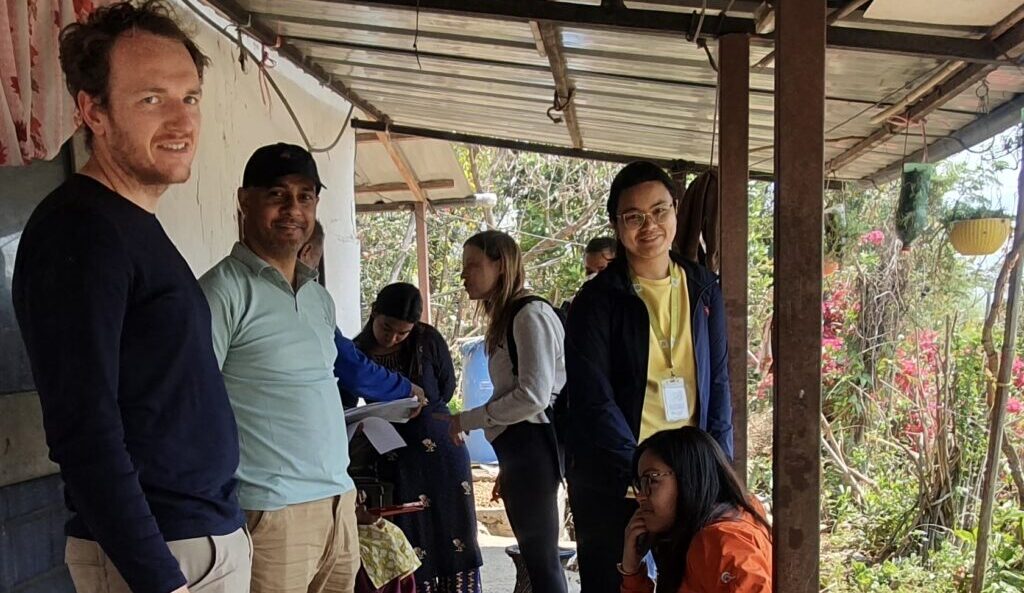
We collected the sample from the caregiver and child’s hands, soil, and effluent and collected the data on waste management practices in both the household with and without the biodigester. We aim to detect the log E. coli MPN in hands and soil along with the presence of antibiotic-resistant and ESBL-producing E. coli and relate it with their practices (waste management and WASH practices) in both households. We are also looking into the influence of bacterial presence on the health outcome of children (diarrhoeal disease).
Team Members
Site Principal Investigator(s): Dr. Dipesh Tamrakar
Co-Investigator(s): Prof. Dr. Rajeev Shrestha, Mr. Sabin Bikram Shahi, Mr. Shiva Ram Naga, Ms. Amy Pickering, Ms. Heather Amato , Mr. Christopher LeBoa
Project Coordinator(s): Ms. Aastha Shrestha
Research Assistant(s): Ms. Urusha Ranjitkar, Ms. Sudichhya Tamrakar, Mr. Prakash Dhimal
Enumerator(s): Ms. Anusha Nayaju, Ms. Smriti Shrestha, Ms. Sangeeta Shrestha, Ms. Pratikshya K.C.
Supported by: Berkeley Food Institute, Berkeley Center for Occupational and Environmental Health, Berkeley Climate Equity and Environmental Justice
Collaborating Partners: University of California-Berkeley, United States, and LEADERS Nepal
Publications
Not Yet Published